CLIMATEAGENT: Multi-Agent Orchestration for Complex Climate Data Science Workflows

arXiv — cs.LGWednesday, November 26, 2025 at 5:00:00 AM
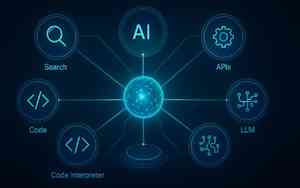
  • Climate science is evolving with the introduction of ClimateAgent, an autonomous multi-agent framework designed to streamline complex climate data workflows. This system breaks down user inquiries into manageable tasks, utilizing various specialized agents to gather data and generate analyses, thus enhancing the efficiency of climate research.
  • The development of ClimateAgent is significant as it addresses the limitations of traditional data processing methods, which often lack the necessary climate-specific context. By automating and optimizing workflows, it promises to improve the accuracy and speed of climate data analysis, making it a valuable tool for researchers and policymakers.
  • This advancement reflects a broader trend in artificial intelligence where multi-agent systems are increasingly being employed to tackle complex problems. Similar initiatives, such as MiroThinker, highlight the growing emphasis on enhancing interactive capabilities and reasoning in AI, suggesting a shift towards more sophisticated, context-aware AI applications in various fields.
— via World Pulse Now AI Editorial System


Was this article worth reading? Share it

Recommended apps based on your readingExplore all apps
Continue Readings
Object Counting with GPT-4o and GPT-5: A Comparative Study
PositiveArtificial Intelligence
A comparative study has been conducted on the object counting capabilities of two multi-modal large language models, GPT-4o and GPT-5, focusing on their performance in zero-shot scenarios using only textual prompts. The evaluation was carried out on the FSC-147 and CARPK datasets, revealing that both models achieved results comparable to state-of-the-art methods, with some instances exceeding them.
A Definition of AGI
NeutralArtificial Intelligence
A recent paper has introduced a quantifiable framework for defining Artificial General Intelligence (AGI), proposing that AGI should match the cognitive versatility of a well-educated adult. This framework is based on the Cattell-Horn-Carroll theory and evaluates AI systems across ten cognitive domains, revealing significant gaps in current AI models, particularly in long-term memory storage.
Anthropic vs. OpenAI red teaming methods reveal different security priorities for enterprise AI
NeutralArtificial Intelligence
Anthropic and OpenAI have recently showcased their respective AI models, Claude Opus 4.5 and GPT-5, highlighting their distinct approaches to security validation through system cards and red-team exercises. Anthropic's extensive 153-page system card contrasts with OpenAI's 60-page version, revealing differing methodologies in assessing AI robustness and security metrics.
\textit{ViRectify}: A Challenging Benchmark for Video Reasoning Correction with Multimodal Large Language Models
PositiveArtificial Intelligence
The introduction of ViRectify marks a significant advancement in the evaluation of multimodal large language models (MLLMs) by providing a comprehensive benchmark for correcting video reasoning errors. This benchmark includes a dataset of over 30,000 instances across various domains, challenging MLLMs to identify errors and generate rationales grounded in video evidence.
Nvidia's new AI framework trains an 8B model to manage tools like a pro
PositiveArtificial Intelligence
Researchers at Nvidia and the University of Hong Kong have introduced Orchestrator, an 8-billion-parameter AI model designed to coordinate various tools and large language models (LLMs) for complex problem-solving. This model demonstrated superior accuracy and cost-effectiveness compared to larger models in tool-use benchmarks, aligning with user preferences for tool selection.
Anthropic study shows leading AI models racking up millions in simulated smart contract exploits
NeutralArtificial Intelligence
A recent study by MATS and Anthropic has revealed that advanced AI models, including Claude Opus 4.5, Sonnet 4.5, and GPT-5, successfully identified and exploited vulnerabilities in smart contracts, simulating exploits worth approximately $4.6 million. This research underscores the growing capabilities of AI in cybersecurity contexts.
DeepSeek-V3.2: Pushing the Frontier of Open Large Language Models
PositiveArtificial Intelligence
DeepSeek-V3.2 has been introduced as a new model that combines high computational efficiency with enhanced reasoning and agent performance, featuring innovations like DeepSeek Sparse Attention and a scalable reinforcement learning framework. This model performs comparably to GPT-5 and even surpasses it in certain high-compute variants, achieving notable success in prestigious competitions such as the 2025 International Mathematical Olympiad.
Study: using the SCONE-bench benchmark of 405 smart contracts, Claude Opus 4.5, Sonnet 4.5, and GPT-5 found and developed exploits collectively worth $4.6M (Anthropic)
NeutralArtificial Intelligence
A recent study utilizing the SCONE-bench benchmark of 405 smart contracts revealed that AI models Claude Opus 4.5, Sonnet 4.5, and GPT-5 collectively identified and developed exploits valued at $4.6 million. This highlights the growing capabilities of AI in cybersecurity tasks, showcasing their potential economic impact.