Qatar Sets Up National AI Firm, Joining Gulf Neighbors

Bloomberg TechnologyMonday, December 8, 2025 at 1:59:35 PM
Qatar Sets Up National AI Firm, Joining Gulf Neighbors
  • Qatar is establishing a national artificial intelligence firm, aiming to develop and invest in AI technologies, thus aligning itself with other Gulf nations that are increasingly investing in this sector.
  • This initiative is significant for Qatar as it seeks to diversify its economy and enhance its technological capabilities, positioning itself as a competitive player in the rapidly evolving AI landscape.
  • The move reflects a broader trend in the region where oil-rich nations are leveraging their resources to invest in advanced technologies, contrasting with challenges faced by other countries like the UK, which struggle to secure funding for critical sectors.
— via World Pulse Now AI Editorial System


Was this article worth reading? Share it

Recommended apps based on your readingExplore all apps
Continue Readings
How 'everyday AI' encourages overconsumption
NeutralArtificial Intelligence
The integration of artificial intelligence into everyday devices, such as watches, phones, and home assistants, is becoming increasingly prevalent, prompting concerns about overconsumption driven by these technologies. This trend highlights how AI is reshaping consumer behavior and expectations in daily life.
Surveying the MLLM Landscape: A Meta-Review of Current Surveys
NeutralArtificial Intelligence
The rise of Multimodal Large Language Models (MLLMs) marks a significant advancement in artificial intelligence, enabling machines to process and generate content across various modalities, including text, images, audio, and video. This meta-review surveys current benchmarks and evaluation methods for MLLMs, addressing foundational concepts, applications, and ethical concerns.
AI Slop Is Spurring Record Requests for Imaginary Journals
NegativeArtificial Intelligence
The International Committee of the Red Cross has raised alarms regarding the proliferation of artificial intelligence models that generate fictitious research papers, journals, and archives, leading to a surge in requests for these non-existent publications. This phenomenon, termed 'AI slop,' poses significant challenges to the integrity of academic and research standards.
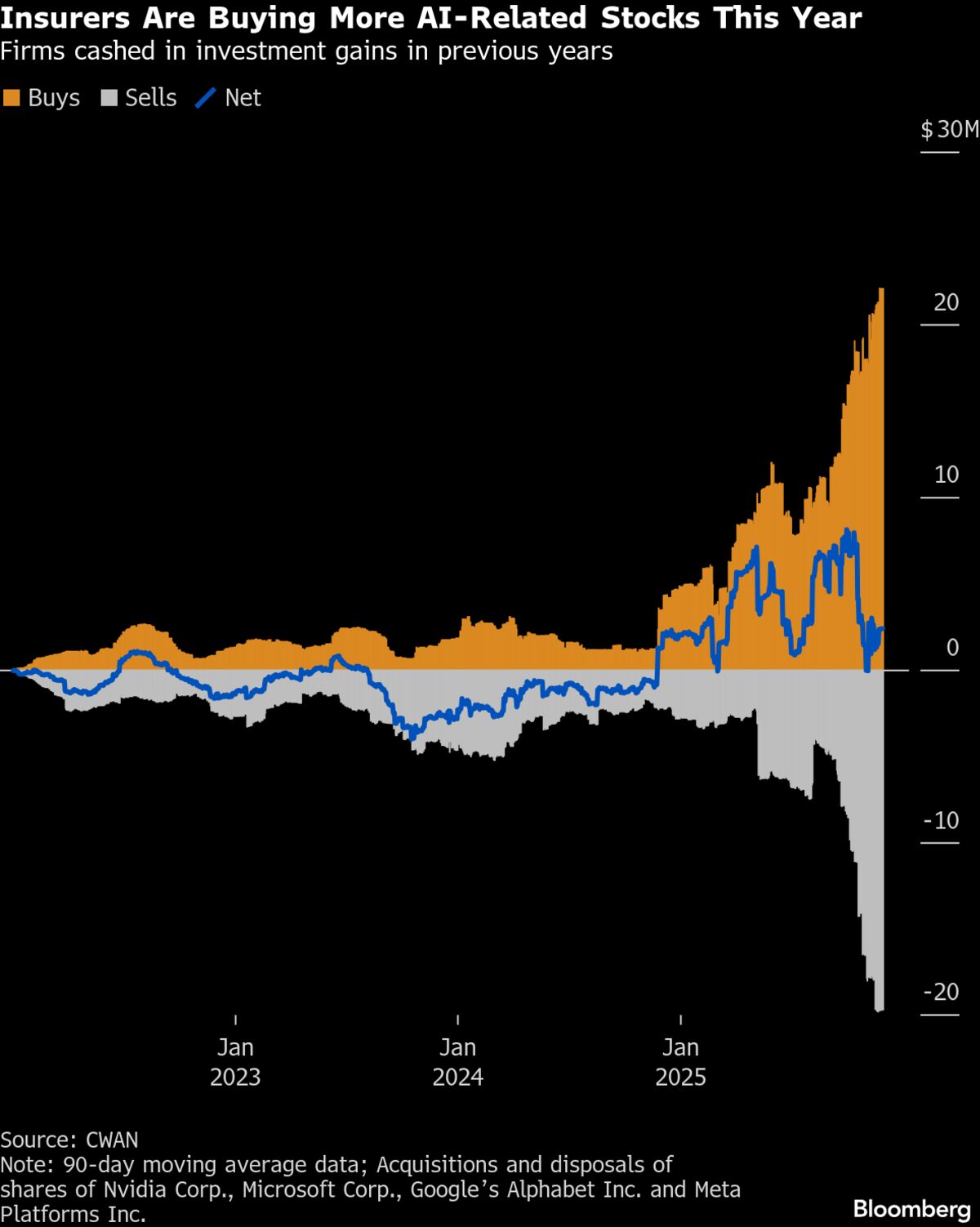
Insurers Are Doubling Down on AI-Related Stocks as Values Soar
PositiveArtificial Intelligence
Insurance companies have significantly increased their investments in artificial intelligence-related stocks during the latter half of the year, capitalizing on the surge in share prices. This trend indicates a strong belief in the potential of AI technologies to drive future growth and profitability.
Over-the-Air Semantic Alignment with Stacked Intelligent Metasurfaces
PositiveArtificial Intelligence
A new framework for over-the-air semantic alignment using stacked intelligent metasurfaces (SIM) has been introduced, aiming to enhance the performance of semantic communication systems by aligning latent representations directly in the wave domain. This approach significantly reduces the computational burden typically associated with existing methods that rely on additional digital processing at the transmitter or receiver.
Uncertainty-Aware Data-Efficient AI: An Information-Theoretic Perspective
NeutralArtificial Intelligence
A recent review paper discusses the challenges faced by artificial intelligence (AI) systems in data-limited contexts, particularly in fields like robotics, telecommunications, and healthcare. It highlights the concept of epistemic uncertainty, which arises from incomplete knowledge of data distributions, and explores methodologies for quantifying this uncertainty and enhancing predictive performance through synthetic data augmentation.
Do We Really Even Need Data? A Modern Look at Drawing Inference with Predicted Data
NeutralArtificial Intelligence
A recent paper discusses the increasing reliance on predicted data as a substitute for missing information in research, particularly as data collection becomes more challenging due to rising costs and declining response rates. The authors highlight the statistical challenges associated with drawing inferences from predicted data, emphasizing that high predictive accuracy does not ensure valid conclusions.