Context-Aware Mixture-of-Experts Inference on CXL-Enabled GPU-NDP Systems

arXiv — cs.LGFriday, December 5, 2025 at 5:00:00 AM
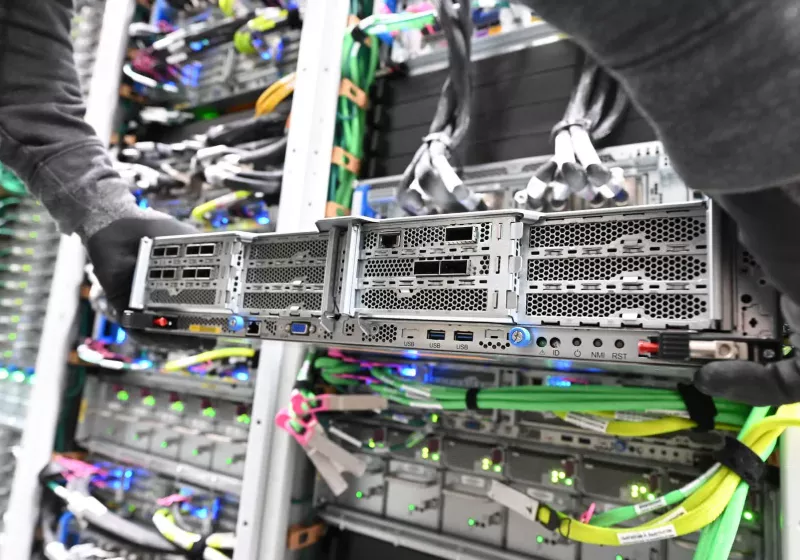
  • A new study presents a context-aware Mixture-of-Experts (MoE) inference system designed for CXL-enabled GPU-near-data processing (NDP) systems. This approach aims to optimize the handling of expert weights that exceed GPU memory capacity by offloading them to external memory, thus reducing costly data transfers and improving efficiency during inference.
  • The development is significant as it addresses the memory limitations faced by large language models, enhancing their performance and scalability. By utilizing CXL-NDP, the system can dynamically manage expert placement based on activation statistics, leading to more efficient resource utilization.
  • This advancement reflects a broader trend in AI research focusing on optimizing model performance through innovative architectures and techniques. The integration of context-aware systems and mixed-precision quantization highlights ongoing efforts to improve the efficiency of Mixture-of-Experts models, which are increasingly being adopted across various applications in machine learning and artificial intelligence.
— via World Pulse Now AI Editorial System

Was this article worth reading? Share it

Recommended apps based on your readingExplore all apps
Continue Readings
ENTIRE: Learning-based Volume Rendering Time Prediction
PositiveArtificial Intelligence
ENTIRE, a new deep learning-based method for predicting volume rendering time, has been introduced, addressing the complexities involved in rendering time prediction due to various factors such as volume data characteristics and camera configurations.
RLHFSpec: Breaking the Efficiency Bottleneck in RLHF Training via Adaptive Drafting
PositiveArtificial Intelligence
The introduction of RLHFSpec marks a significant advancement in the efficiency of Reinforcement Learning from Human Feedback (RLHF) training for large language models (LLMs). This system integrates adaptive speculative decoding and sample reallocation to address the bottleneck in the generation stage of RLHF, thereby optimizing the overall execution process.
CXL Adds Port Bundling to Quench AI Thirst
PositiveArtificial Intelligence
CXL 4.0 has introduced port bundling, effectively doubling the bandwidth available for AI-driven GPUs, addressing the increasing demands of artificial intelligence applications. This enhancement is crucial as AI technologies continue to evolve and require more robust hardware capabilities.
Astra: A Multi-Agent System for GPU Kernel Performance Optimization
PositiveArtificial Intelligence
Astra has been introduced as a pioneering multi-agent system designed for optimizing GPU kernel performance, addressing a long-standing challenge in high-performance computing and machine learning. This system leverages existing CUDA implementations from SGLang, a framework widely used for serving large language models (LLMs), marking a shift from traditional manual tuning methods.
Stabilizing Reinforcement Learning with LLMs: Formulation and Practices
PositiveArtificial Intelligence
A novel formulation for reinforcement learning (RL) with large language models (LLMs) has been proposed, highlighting the optimization of true sequence-level rewards via a surrogate token-level objective in policy gradient methods like REINFORCE. The study emphasizes minimizing training-inference discrepancies and policy staleness to enhance the validity of this approach.
Pan-LUT: Efficient Pan-sharpening via Learnable Look-Up Tables
PositiveArtificial Intelligence
A novel pan-sharpening framework called Pan-LUT has been introduced, leveraging learnable look-up tables to enhance the processing of large remote sensing images efficiently. This method allows for the handling of 15K*15K images on a 24GB GPU, addressing the computational challenges faced by traditional deep learning approaches in real-world applications.
S5: Scalable Semi-Supervised Semantic Segmentation in Remote Sensing
PositiveArtificial Intelligence
A new framework named S5 has been introduced for scalable semi-supervised semantic segmentation in remote sensing, enhancing the analysis of Earth observation data by utilizing vast amounts of unlabeled data through innovative techniques like pseudo-labeling and consistency learning. This framework builds upon existing large-scale datasets and introduces the RS4P-1M dataset, which employs a data selection strategy for improved model performance.
Amazon is building AI "factories" to run Trainium and GPU racks inside customer data centers
NeutralArtificial Intelligence
Amazon is developing AI "factories" designed to operate Trainium and GPU racks within customer data centers, addressing the unique needs of enterprises that face challenges in integrating AI into their existing infrastructures. This initiative aims to enhance the deployment of AI technologies across various sectors.