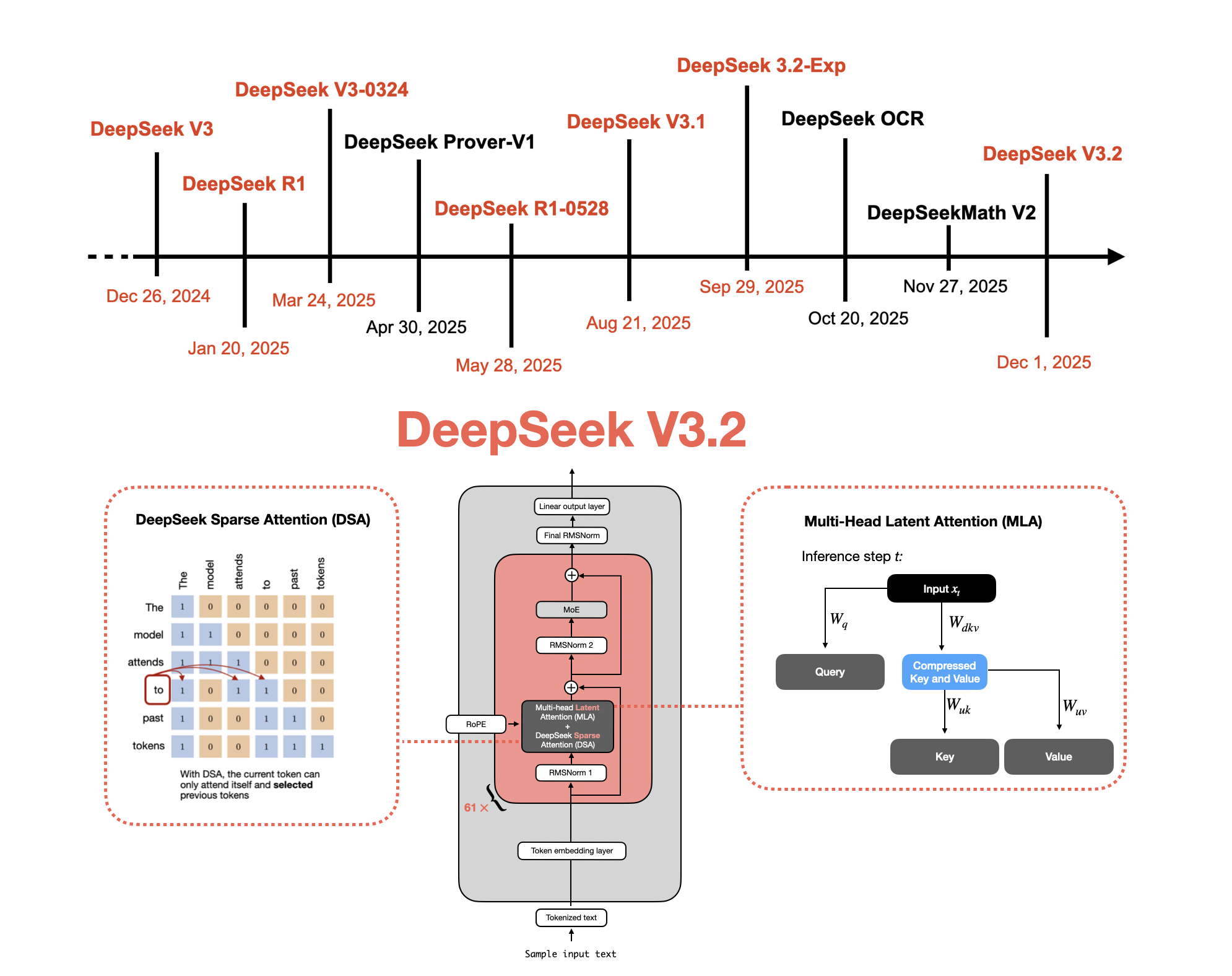
A Technical Tour of the DeepSeek Models from V3 to V3.2

Ahead of AIWednesday, December 3, 2025 at 12:03:33 PM
A Technical Tour of the DeepSeek Models from V3 to V3.2
  • DeepSeek has showcased the evolution of its flagship open-weight models from V3 to V3.2, highlighting advancements in artificial intelligence capabilities. This technical tour provides insights into the enhancements made to the models, which are designed to compete effectively in the AI landscape.
  • The development of the V3.2 model is significant for DeepSeek as it positions the company to challenge established players like Google and OpenAI, reflecting its commitment to innovation and competitiveness in the rapidly evolving AI sector.
  • This evolution of DeepSeek's models underscores a broader trend in the AI industry, where companies are racing to develop advanced systems capable of complex reasoning and problem-solving, amidst increasing competition and the need for cutting-edge technology.
— via World Pulse Now AI Editorial System

Was this article worth reading? Share it

Recommended apps based on your readingExplore all apps
Continue Readings
DeepSeek's New Models Reveal Open Source Complexities
NeutralArtificial Intelligence
DeepSeek has introduced new AI models that are comparable to existing offerings in the market, raising questions about the company's business strategy and approach to open-source technology. This development comes as the company aims to position itself against major competitors like Google and OpenAI.
Mixture of Ranks with Degradation-Aware Routing for One-Step Real-World Image Super-Resolution
PositiveArtificial Intelligence
A new Mixture-of-Ranks (MoR) architecture has been proposed for one-step real-world image super-resolution (Real-ISR), integrating sparse Mixture-of-Experts (MoE) to enhance the adaptability of models in reconstructing high-resolution images from degraded samples. This approach utilizes a fine-grained expert partitioning strategy, treating each rank in Low-Rank Adaptation (LoRA) as an independent expert, thereby improving the model's ability to capture heterogeneous characteristics of real-world images.
DeepSeek Unleashes New AI Models to Challenge Google and OpenAI
PositiveArtificial Intelligence
DeepSeek has launched new AI models aimed at competing with industry giants Google and OpenAI, marking a significant step in the global AI race. This development highlights the ongoing efforts to create advanced AI systems capable of complex reasoning and problem-solving.
Mistral launches Mistral 3, a family of open models designed to run on laptops, drones, and edge devices
PositiveArtificial Intelligence
Mistral AI has launched the Mistral 3 family, a suite of 10 open-source AI models designed for various platforms, including laptops, drones, and edge devices. This release marks a significant step in the company's strategy to compete against major players like OpenAI and Google by providing accessible AI solutions across different applications.
Will DeepSeek’s new model spark another global AI shake-up in 2026?
NeutralArtificial Intelligence
DeepSeek is set to launch its new AI model, R2, after delays attributed to limited access to computing resources. This development is expected to heighten the ongoing competition between the U.S. and China in the artificial intelligence sector.
DeepSeek strikes again
PositiveArtificial Intelligence
DeepSeek has made headlines again with its recent advancements in artificial intelligence, particularly with the introduction of its new model, DeepSeekMath-V2, which has achieved gold medal status at both the International Mathematical Olympiad 2025 and the Chinese Mathematical Olympiad 2024. This achievement highlights the company's growing influence in the AI sector.
Efficient Training of Diffusion Mixture-of-Experts Models: A Practical Recipe
PositiveArtificial Intelligence
Recent advancements in Diffusion Mixture-of-Experts (MoE) models have shifted focus from routing mechanisms to architectural configurations, revealing that factors like expert modules and attention encodings are crucial for model effectiveness. This systematic study emphasizes the importance of tuning these configurations to maximize performance in both latent and pixel-space diffusion frameworks.