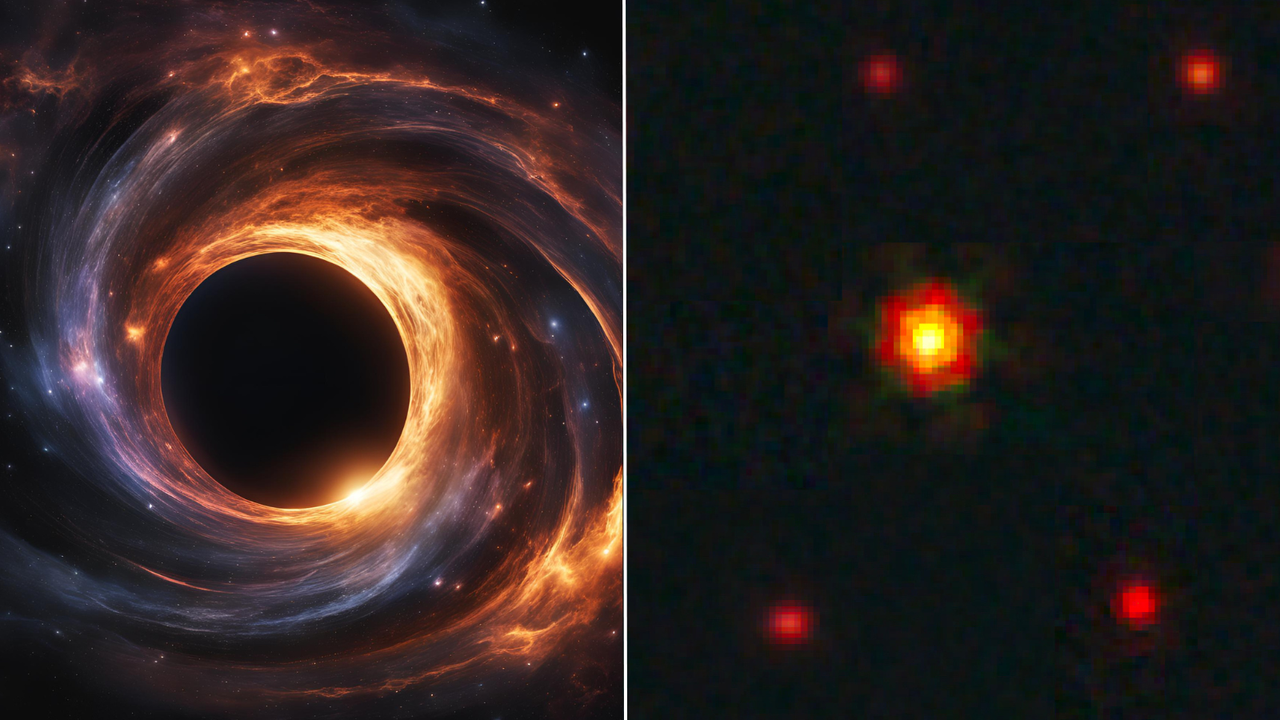
James Webb Space telescope spots 'big red dot' in the ancient universe: A ravenous supermassive black hole named 'BiRD'

Space.comTuesday, November 4, 2025 at 11:00:00 PM
PositiveScience
James Webb Space telescope spots 'big red dot' in the ancient universe: A ravenous supermassive black hole named 'BiRD'
The James Webb Space Telescope has identified a supermassive black hole named "BiRD" in the ancient universe, marking a significant discovery in extragalactic astrophysics. This finding, confirmed by recent observations, highlights the telescope's capability to detect distant and powerful cosmic phenomena. The presence of such a ravenous black hole at an early stage of the universe provides valuable insights into the formation and growth of massive celestial objects. According to Space.com, this breakthrough opens new possibilities for understanding the evolution of galaxies and the dynamics of the early cosmos. The discovery's significance lies in its potential to reveal many more surprises as the James Webb Space Telescope continues its mission. This development underscores the importance of advanced space telescopes in expanding our knowledge of the universe's distant past.
— via World Pulse Now AI Editorial System
Was this article worth reading? Share it

Recommended apps based on your readingExplore all apps
Continue Readings
Strange, 'starved' galaxy died 'a death of 1,000 cuts' in the ancient universe, JWST reveals
NeutralScience
New observations from the James Webb Space Telescope (JWST) reveal that a supermassive black hole in an ancient galaxy likely starved the galaxy of gas necessary for star formation, leading to its demise described as 'a death of 1,000 cuts'. This finding enhances understanding of the early universe's dynamics.
The universe should be packed with tiny galaxies — so where are they?
NeutralScience
Astronomers have observed that the early universe may not contain as many small galaxies as previously predicted, raising questions about the formation and evolution of the cosmos. This discrepancy suggests that the models used to understand galaxy formation may need to be reevaluated.

Ready to build your own newsroom?

Subscribe to unlock a personalised feed, podcasts, newsletters, and notifications tailored to the topics you actually care about