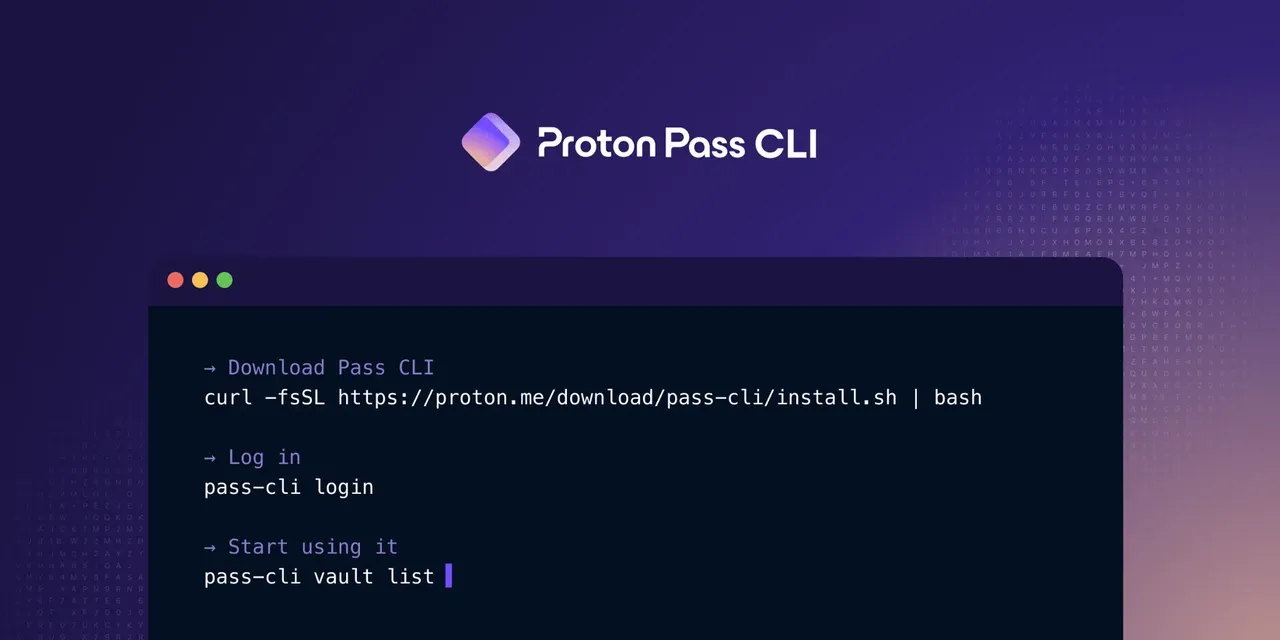
Proton Pass just made it even easier for developers to retrieve secrets — and that's a win for everyone involved

TechRadarWednesday, December 10, 2025 at 5:20:00 PM
PositiveTechnology
Proton Pass just made it even easier for developers to retrieve secrets — and that's a win for everyone involved
  • Proton Pass has introduced a command-line interface, enhancing the ease with which developers can retrieve secrets, a feature that users have been eagerly anticipating. This update aims to streamline workflows and improve user experience in managing sensitive information.
  • The addition of the command-line interface is a significant step for Proton Pass, as it aligns with the company's commitment to providing user-friendly tools that enhance security and efficiency in data management, ultimately fostering greater trust among its user base.
  • This development reflects a broader trend in the technology sector, where companies are increasingly focusing on user-centric features that simplify complex processes. The introduction of tools like Proton Sheets, which offer end-to-end encryption for document handling, further underscores the industry's push towards robust security solutions that cater to the evolving needs of users.
— via World Pulse Now AI Editorial System


Was this article worth reading? Share it

Recommended apps based on your readingExplore all apps
Continue Readings
Vibe Coding: convenience, risk and the future of software development
NeutralTechnology
Vibe coding has emerged as a new approach to software development, aiming to make programming more accessible and reduce repetitive tasks. While it offers the potential to enhance tech literacy among a broader audience, it also presents significant risks that could impact the quality and reliability of software.
Why the flash crisis will last much longer this time
NegativeTechnology
The widening gap between SSD and HDD costs indicates a prolonged flash crisis, with no signs of stabilization in sight. This trend is attributed to ongoing supply chain issues and increased demand for storage solutions, particularly in sectors reliant on high-performance computing.
UK Lords propose ban on VPNs for children
NegativeTechnology
The UK House of Lords has proposed an amendment to ban the use of Virtual Private Networks (VPNs) for individuals under the age of 16, a move that has generated significant debate regarding internet access and privacy for younger users. The future of this amendment remains uncertain as discussions continue among lawmakers.
ChatGPT 5.2 branded a ‘step backwards’ by disappointed early users – here’s why
NegativeTechnology
ChatGPT 5.2 has been released, but early users on Reddit have expressed disappointment, labeling the update as 'boring' and claiming it is inferior to version 5.1. This negative sentiment highlights user dissatisfaction with the latest iteration of the AI model.
OpenAI admits new models likely to pose 'high' cybersecurity risk
NegativeTechnology
OpenAI has acknowledged that its new models are likely to pose a 'high' cybersecurity risk, emphasizing that while advancements in AI technology can enhance capabilities, they also introduce significant vulnerabilities. The company is exploring mitigations to address these risks.
Russian airline hack came through third-party tech vendor
NegativeTechnology
A significant breach at a Russian airline was reportedly executed by Ukrainian and Belarussian hacktivists through a third-party technology vendor, raising alarms about cybersecurity vulnerabilities within the aviation sector. Local journalists are currently investigating the incident, which occurred last summer.
HPC and AI converging infrastructures
NeutralTechnology
The modern data center is experiencing a transformation due to the integration of artificial intelligence (AI) and high-performance computing (HPC), which is reshaping infrastructure demands and operational capabilities. This convergence is driven by the need for enhanced computational power to manage increasingly complex data workloads.
Quantifying the hidden costs of cloud sovereignty gaps
NegativeTechnology
Recent outages have highlighted the vulnerabilities associated with an over-reliance on US-based hyperscalers for cloud services, raising concerns about cloud sovereignty gaps. These incidents underscore the potential risks that organizations face when dependent on a limited number of providers for critical infrastructure.

Ready to build your own newsroom?

Subscribe once and get a personalised feed, podcast, newsletter, and notifications tuned to the topics you actually care about.