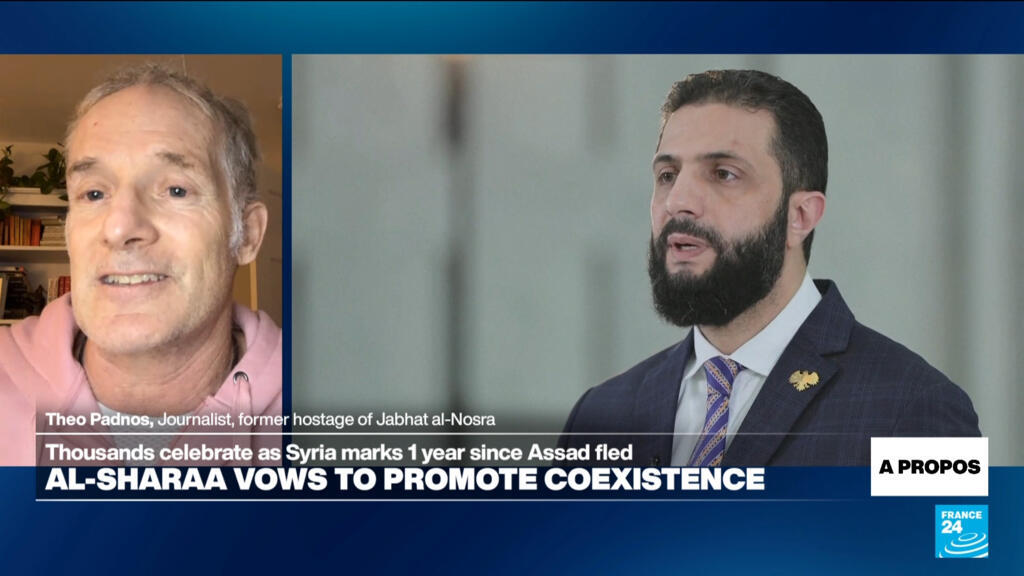
Syrian president Sharaa fostered 'genocidal culture' against minorities, former hostage says

France 24Monday, December 8, 2025 at 10:19:47 PM
Syrian president Sharaa fostered 'genocidal culture' against minorities, former hostage says
  • Theo Padnos, a journalist and former hostage, has accused Syrian President Ahmed al-Sharaa of fostering a 'genocidal culture' against minorities during his leadership of jihadist groups, highlighting the indiscriminate killings that occurred under his watch. This statement was made during an interview with FRANCE 24, emphasizing the ongoing human rights concerns in Syria.
  • The remarks from Padnos are significant as they shed light on the actions of al-Sharaa, who has recently taken on a prominent role in Syria's interim government. His leadership is under scrutiny as the country grapples with its tumultuous past and seeks to establish a new political order.
  • Al-Sharaa's presidency comes at a time of heightened tensions in the region, particularly with Israel, which has been accused of exacerbating crises in Syria. The complexities of Sharaa's rule are further compounded by the challenges of rebuilding a fragmented society and addressing the legacy of violence that has marked the Syrian conflict.
— via World Pulse Now AI Editorial System
Was this article worth reading? Share it

Recommended apps based on your readingExplore all apps
Continue Readings
Taking stock of Sharaa’s rule in Syria, one year after the fall of Assad
NeutralWorld Affairs
One year after the fall of Bashar al-Assad, Syria is navigating a complex transition under the leadership of Interim President Ahmed al-Sharaa, who faces significant challenges including a struggling economy and a fragmented society. The recent anniversary has been marked by celebrations in cities like Hama, reflecting a mix of hope and ongoing difficulties.
Can Syria’s president turn wave of global goodwill into tangible results at home?
NeutralWorld Affairs
Ahmed al-Sharaa, who became Syria's president on January 29, 2025, has embarked on an extensive diplomatic campaign, making 21 international trips to 13 countries, including significant events like the UN General Assembly and climate change conference in Brazil. However, challenges such as sanctions, instability, and external interference continue to hinder progress in the country one year after the fall of Bashar al-Assad's regime.