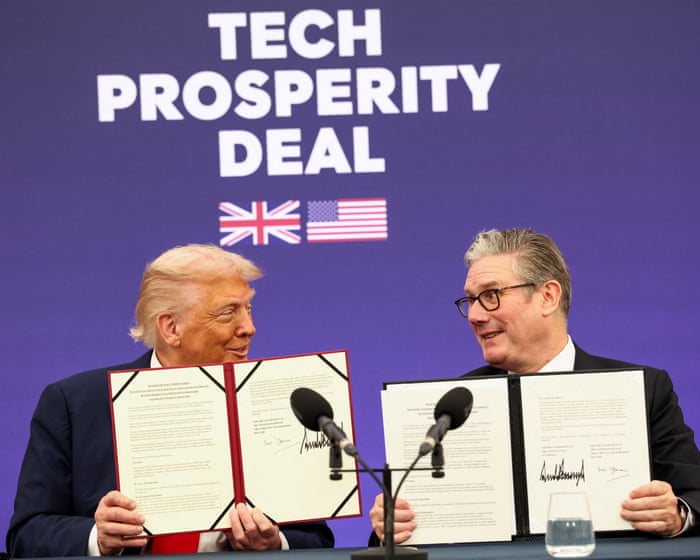
US puts £31bn tech ‘prosperity deal’ with Britain on ice

The Guardian — Artificial IntelligenceMonday, December 15, 2025 at 7:37:50 PM
US puts £31bn tech ‘prosperity deal’ with Britain on ice
  • The United States has paused its £31 billion tech prosperity deal with Britain, citing insufficient progress on resolving trade barriers. This decision represents a significant setback in US-UK relations, particularly as the deal was initially celebrated as a transformative step in bilateral cooperation during Donald Trump's presidency.
  • The suspension of this investment deal raises concerns for the UK, particularly for Prime Minister Keir Starmer, who viewed it as a crucial opportunity to enhance the UK's tech sector and strengthen economic ties with the US amid ongoing trade negotiations.
  • This development reflects broader tensions in US-UK relations, as British MPs have recently warned of the US adopting extreme rightwing ideologies reminiscent of the 1930s, which could impact European democracies. Additionally, the UK is seeking to diversify its trade relationships, as evidenced by a new deal with South Korea, highlighting the shifting dynamics in international trade.
— via World Pulse Now AI Editorial System


Was this article worth reading? Share it

Recommended apps based on your readingExplore all apps
Continue Readings
Sources: the US has paused a tech trade deal with the UK, signed in September, over disagreements about the UK's digital regulations and food safety rules (New York Times)
NegativeArtificial Intelligence
The United States has paused a £31 billion tech trade deal with the UK, originally signed in September, due to disagreements surrounding the UK's digital regulations and food safety rules. This decision reflects ongoing tensions in US-UK trade relations, particularly in the technology sector.
News Bytes 20251215: On-Off-On GPU Exports to China, the US-China Power Gap, Pocket-Sized HPC, Regulating AI
NeutralArtificial Intelligence
The Trump administration has granted Nvidia approval to export its H200 AI chips to China, following extensive negotiations. This decision includes a stipulation of a 25% fee on sales, which will be charged upon shipment. The approval reflects a significant shift in U.S. export policy amidst ongoing tensions between the two nations.
What's at stake in Trump's executive order aiming to curb state-level AI regulation
NeutralArtificial Intelligence
President Donald Trump signed an executive order on December 11, 2025, aimed at overriding state-level regulations on artificial intelligence (AI), which the administration believes hinder innovation in the sector. This order establishes a federal task force to challenge state laws that may restrict AI development.
Canada Pushes to Retain Quantum Computing Firms as US Competition Grows
PositiveArtificial Intelligence
The Canadian government has announced a funding initiative of up to C$92 million ($66.8 million) aimed at supporting quantum computing firms in Canada as competition from the United States intensifies in this emerging technology sector. This move is part of a broader strategy to retain domestic talent and innovation in quantum computing.
A look at Trump's AI EO and how its interstate commerce argument could backfire by invalidating laws in GOP states targeting "Big Tech censorship" (Mike Masnick/Techdirt)
NegativeArtificial Intelligence
President Donald Trump signed an executive order aimed at preventing states from regulating artificial intelligence (AI), arguing that state-level regulations hinder innovation. This move is seen as an effort to establish a unified federal framework for AI oversight, which could invalidate existing laws in GOP states that target perceived 'Big Tech censorship.'
Despite talk of an existential US-China AI race, the Chinese state and its major companies are spending more to dominate other domains, such as EVs and robotics (Tim Wu/Financial Times)
NeutralArtificial Intelligence
Despite the ongoing narrative of a US-China AI race, recent analysis indicates that China is prioritizing investments in sectors beyond AI, such as electric vehicles (EVs) and robotics. Major Chinese companies and the state are channeling resources into these domains, suggesting a strategic shift in focus.

Ready to build your own newsroom?

Subscribe to unlock a personalised feed, podcasts, newsletters, and notifications tailored to the topics you actually care about