The Moral Consistency Pipeline: Continuous Ethical Evaluation for Large Language Models

arXiv — cs.CLWednesday, December 3, 2025 at 5:00:00 AM
  • The rapid advancement of Large Language Models (LLMs) has prompted the introduction of the Moral Consistency Pipeline (MoCoP), a framework designed for continuous ethical evaluation of these models. MoCoP operates without static datasets, employing a self-sustaining architecture that autonomously generates and refines ethical scenarios, thereby addressing the limitations of existing alignment frameworks that often rely on post-hoc evaluations.
  • This development is significant as it aims to enhance the ethical coherence of LLMs, ensuring that their reasoning remains consistent across various contexts. By implementing MoCoP, developers can better align model behavior with human ethical standards, potentially reducing the risks associated with deploying LLMs in sensitive applications.
  • The introduction of MoCoP reflects a growing recognition of the ethical challenges posed by LLMs, particularly regarding biases and decision-making processes. As LLMs become more integrated into various sectors, the need for frameworks that ensure ethical stability is critical. This aligns with ongoing discussions about the implications of AI behavior, the necessity for robust evaluation methods, and the importance of addressing biases inherited from training data.
— via World Pulse Now AI Editorial System
Was this article worth reading? Share it

Recommended apps based on your readingExplore all apps
Continue Readings
DeepSeek's New Models Reveal Open Source Complexities
NeutralArtificial Intelligence
DeepSeek has introduced new AI models that are comparable to existing offerings in the market, raising questions about the company's business strategy and approach to open-source technology. This development comes as the company aims to position itself against major competitors like Google and OpenAI.
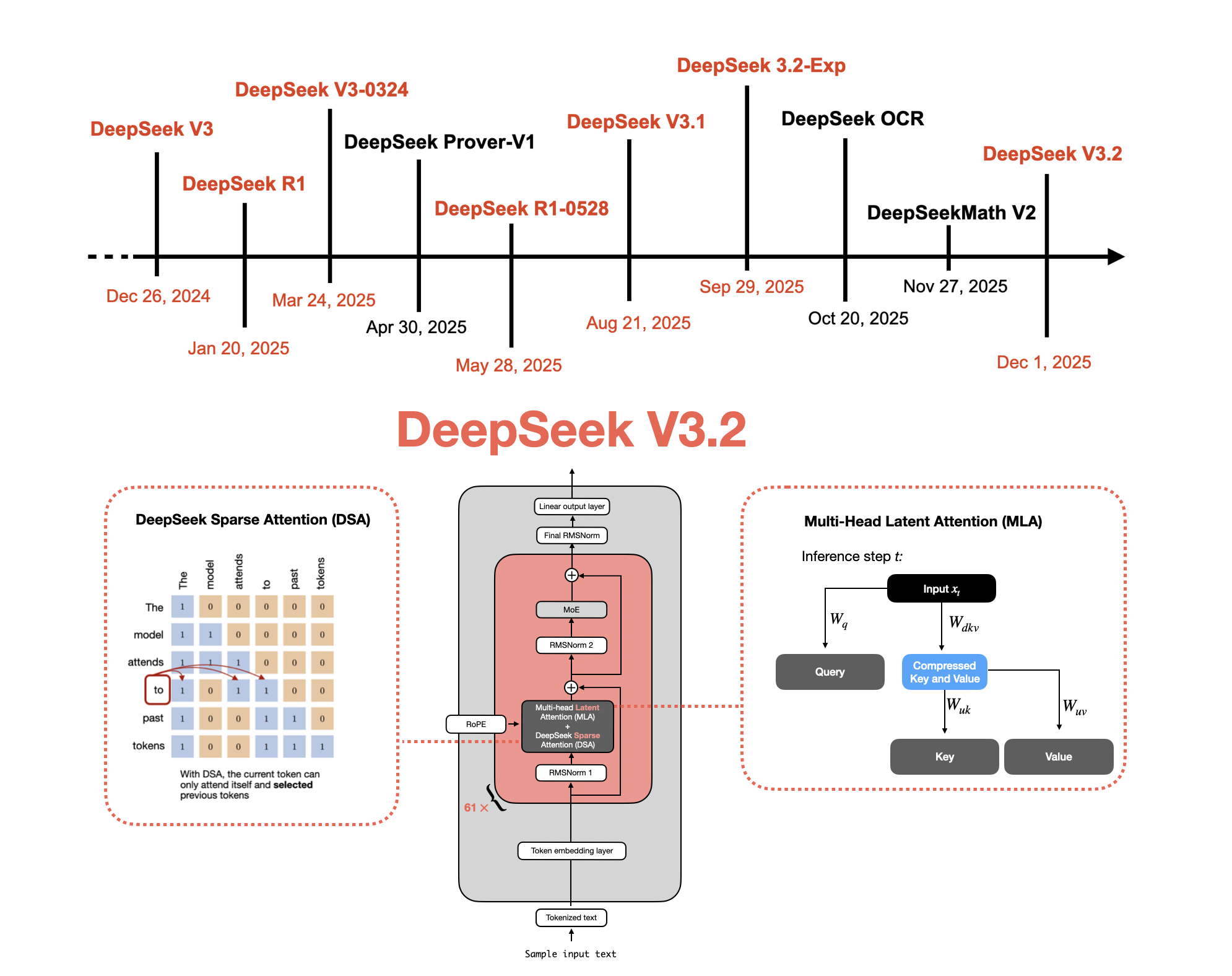
A Technical Tour of the DeepSeek Models from V3 to V3.2
NeutralArtificial Intelligence
DeepSeek has showcased the evolution of its flagship open-weight models from V3 to V3.2, highlighting advancements in artificial intelligence capabilities. This technical tour provides insights into the enhancements made to the models, which are designed to compete effectively in the AI landscape.
SkeletonAgent: An Agentic Interaction Framework for Skeleton-based Action Recognition
PositiveArtificial Intelligence
The SkeletonAgent framework has been introduced to enhance skeleton-based action recognition by integrating Large Language Models (LLMs) with a recognition model through two cooperative agents, the Questioner and Selector. This innovative approach aims to improve the accuracy of distinguishing similar actions by providing targeted guidance and feedback between the LLM and the recognition model.
Masking Matters: Unlocking the Spatial Reasoning Capabilities of LLMs for 3D Scene-Language Understanding
PositiveArtificial Intelligence
Recent advancements in 3D scene-language understanding have led to the development of the 3D Spatial Language Instruction Mask (3D-SLIM), which enhances the reasoning capabilities of Large Language Models (LLMs) by replacing traditional causal attention masks with adaptive attention masks tailored to the spatial structures of 3D scenes. This innovation addresses key limitations in current methodologies, such as sequential bias and restricted attention in task-specific reasoning.
Mixture of Ranks with Degradation-Aware Routing for One-Step Real-World Image Super-Resolution
PositiveArtificial Intelligence
A new Mixture-of-Ranks (MoR) architecture has been proposed for one-step real-world image super-resolution (Real-ISR), integrating sparse Mixture-of-Experts (MoE) to enhance the adaptability of models in reconstructing high-resolution images from degraded samples. This approach utilizes a fine-grained expert partitioning strategy, treating each rank in Low-Rank Adaptation (LoRA) as an independent expert, thereby improving the model's ability to capture heterogeneous characteristics of real-world images.
Towards Unification of Hallucination Detection and Fact Verification for Large Language Models
PositiveArtificial Intelligence
A new framework named UniFact has been introduced to unify Hallucination Detection (HD) and Fact Verification (FV) for Large Language Models (LLMs), addressing the prevalent issue of LLMs generating factually incorrect content, known as hallucinations. This initiative aims to bridge the gap between two previously isolated research paradigms, enhancing the evaluation of LLM outputs.
A benchmark dataset for evaluating Syndrome Differentiation and Treatment in large language models
PositiveArtificial Intelligence
A new benchmark dataset, TCM-BEST4SDT, has been proposed to evaluate the capabilities of Large Language Models (LLMs) in the context of Traditional Chinese Medicine (TCM), specifically focusing on Syndrome Differentiation and Treatment (SDT). This dataset aims to address the challenges posed by TCM's individualized and holistic nature, which current evaluation frameworks often overlook.
SR-GRPO: Stable Rank as an Intrinsic Geometric Reward for Large Language Model Alignment
PositiveArtificial Intelligence
A new study introduces Stable Rank Group Relative Policy Optimization (SR-GRPO), which utilizes stable rank as an intrinsic quality signal for aligning Large Language Models (LLMs) with human preferences, addressing limitations of traditional methods that rely on external supervision. The stable rank measures the effective dimensionality of hidden states, achieving notable improvements in task accuracy.
