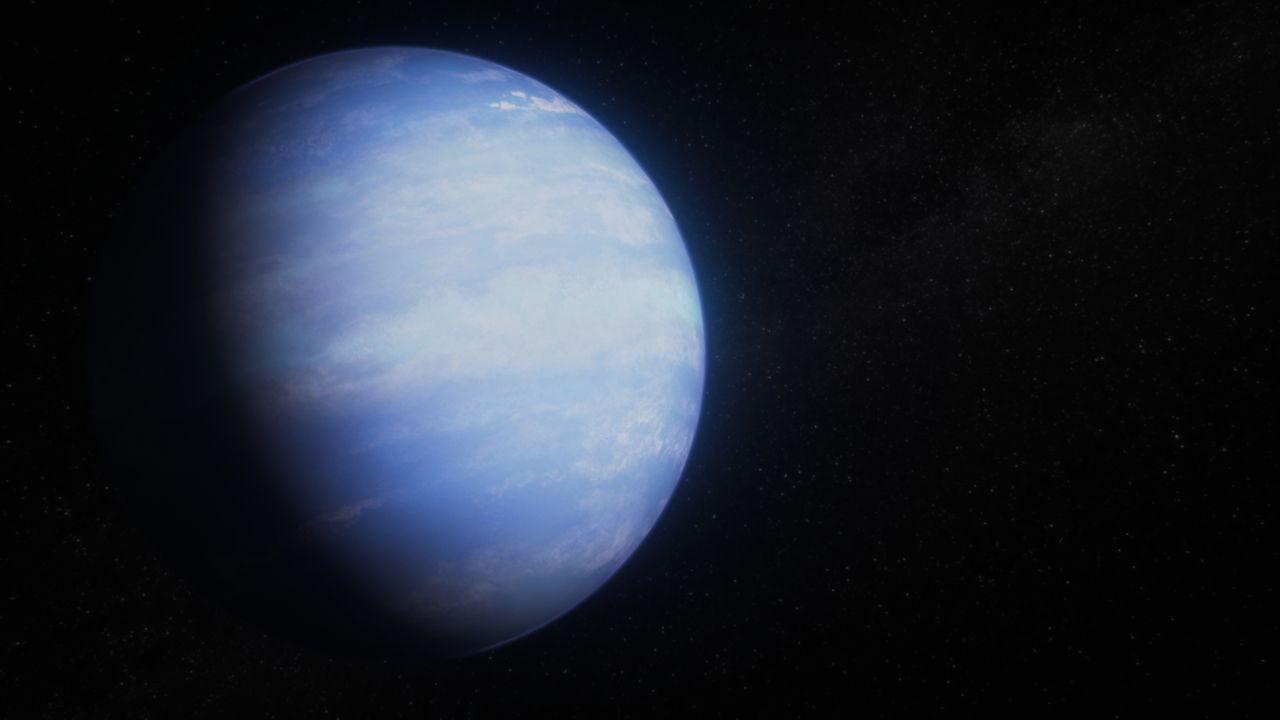
A 'super-puff' exoplanet is losing its atmosphere, and the James Webb Space Telescope had a look

Space.comWednesday, December 3, 2025 at 1:00:00 PM
NeutralScience
A 'super-puff' exoplanet is losing its atmosphere, and the James Webb Space Telescope had a look
  • Astronomers have observed a distant exoplanet, known as a 'super-puff', actively losing its atmosphere into space, forming a significant helium gas cloud that extends beyond its parent star. This real-time observation was made possible by the James Webb Space Telescope, highlighting the dynamic nature of planetary atmospheres.
  • The discovery is crucial as it provides insights into the atmospheric loss processes of exoplanets, which can affect their habitability and evolution. Understanding these mechanisms is vital for future studies of planetary systems and their potential for supporting life.
  • This finding aligns with ongoing research into the behavior of celestial bodies, including the detection of unusual phenomena such as dust particles traveling far from their galaxies and the dynamics of gas in early galaxies. These observations contribute to a broader understanding of cosmic evolution and the life cycles of stars and planets.
— via World Pulse Now AI Editorial System

Was this article worth reading? Share it

Recommended apps based on your readingExplore all apps
Continue Readings
An industrial project in Chile threatens Earth's darkest sky. 28 leading astronomers signed an open letter urging to move it
NegativeScience
A significant industrial project in Chile has raised concerns among astronomers, as 28 leading experts signed an open letter urging its relocation due to its potential to brighten the night sky. This change could hinder the observation of approximately 30% of the faintest galaxies and impede the study of exoplanet atmospheres, which are crucial for understanding the universe's complexities.
The James Webb Space Telescope just found the oldest supernova ever seen
PositiveScience
The James Webb Space Telescope (JWST) has made a groundbreaking discovery by identifying the oldest supernova ever observed, which exploded over 13 billion years ago in a distant galaxy. This finding sheds light on the early universe and the processes that shaped it.
Pair of exploding stars baffle astronomers
NeutralScience
Astronomers have recently captured new images of two novae, which are cosmic explosions resulting from the thermonuclear explosion of a star, described as a transition from a grainy black-and-white photo to high-definition video. This advancement in imaging technology has provided unprecedented clarity in observing these stellar phenomena.