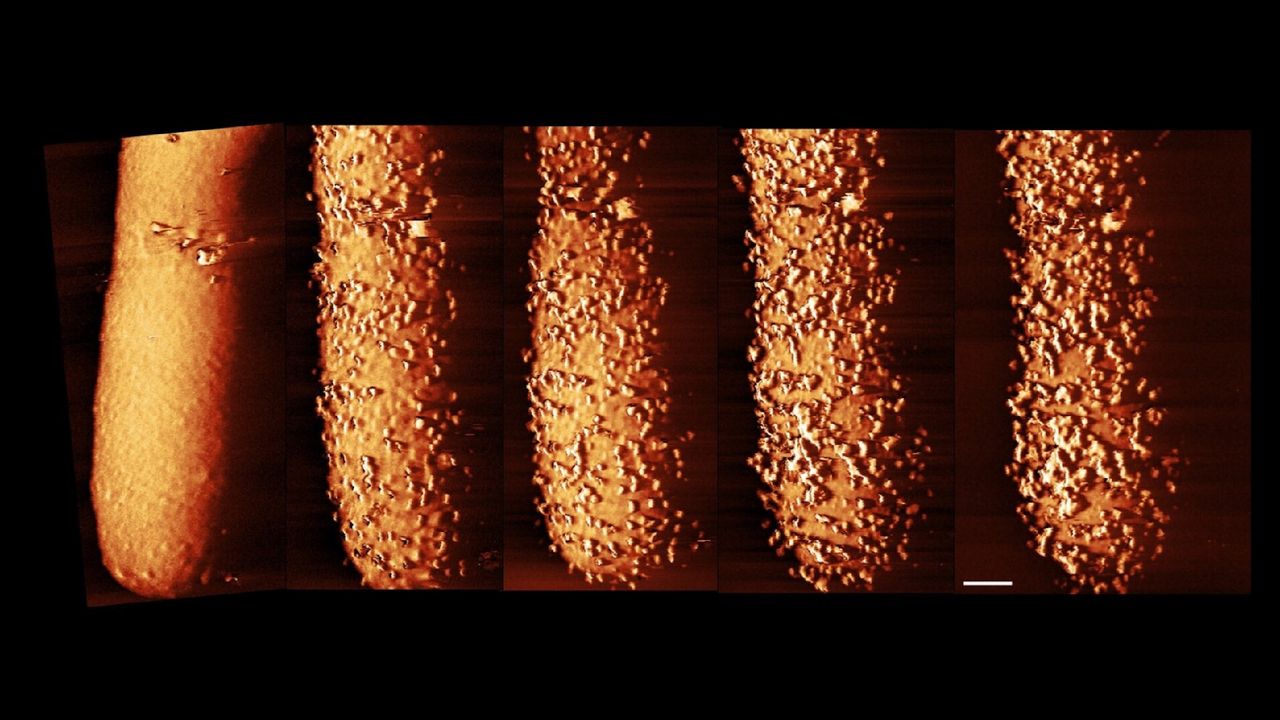
Striking images capture an antibiotic slaying bacteria in real time

Live ScienceSunday, October 5, 2025 at 5:00:00 PM
PositiveScience
Striking images capture an antibiotic slaying bacteria in real time
Scientists have made a groundbreaking advancement by capturing real-time images of polymyxins, a powerful class of antibiotics, as they disrupt and infiltrate the membranes of harmful bacteria. This discovery is significant because it not only enhances our understanding of how antibiotics work but also opens the door for developing more effective treatments against antibiotic-resistant infections.
— via World Pulse Now AI Editorial System

Was this article worth reading? Share it

Recommended Readings
Scientists invent way to use E. coli to create and dye rainbow-colored fabric in the lab
PositiveScience
Scientists have developed a new method to create sustainable, rainbow-colored fibers using E. coli bacteria in the laboratory. This innovative approach highlights the potential of biotechnology in producing environmentally friendly materials.
80 years ago, a WWII B-17 bomber crashed in the Baltic. Scientists are finally learning who was onboard.
PositiveScience
Eighty years after a B-17 bomber crashed in the Baltic Sea during World War II, scientists are making progress in identifying the crew members who were onboard. The investigation focuses on preserved machine guns found at the crash site, which may provide crucial information about the lost Flying Fortress crew. This ongoing scientific effort aims to uncover the identities of those who perished in the incident.
Scientists Unearth Mysterious Meteorite Crater in China
NeutralScience
Thousands of years ago, a space rock impacted what is now China, resulting in the formation of a bowl-shaped meteorite crater approximately 900 meters wide. This discovery sheds light on the geological history of the region and the effects of extraterrestrial impacts on Earth.
Jeffrey Epstein E-mails Reveal Ties to Prominent Scientists
NeutralScience
A trove of e-mails from convicted sex offender Jeffrey Epstein was released by a congressional committee on Wednesday. These emails reveal connections between Epstein and several prominent scientists, shedding light on his extensive network and influence. The release of these emails raises questions about the implications of such ties in the scientific community and beyond.
New 'Dragon Hatchling' AI architecture modeled after the human brain could be a key step toward AGI, researchers claim
PositiveScience
Researchers have introduced a new AI architecture called 'Dragon Hatchling', which is modeled after the human brain. They claim that this innovative design could bridge the gap between existing AI systems and machines that are capable of learning and thinking in a manner similar to humans. This development is seen as a significant step toward achieving artificial general intelligence (AGI).
Scientists Might Soon Predict the Ocean’s Rogue Waves
PositiveScience
An 18-year dataset from the North Sea reveals that rogue waves are not freak accidents but particular products of ordinary swells stacking up—an insight that could make prediction possible.
Scientists find a surprising twist in Earth's magnetic field
NeutralScience
New research indicates that parts of Earth's magnetic field operate in reverse compared to predictions made by long-standing models. This unexpected behavior challenges previous understandings of the magnetic field's dynamics.