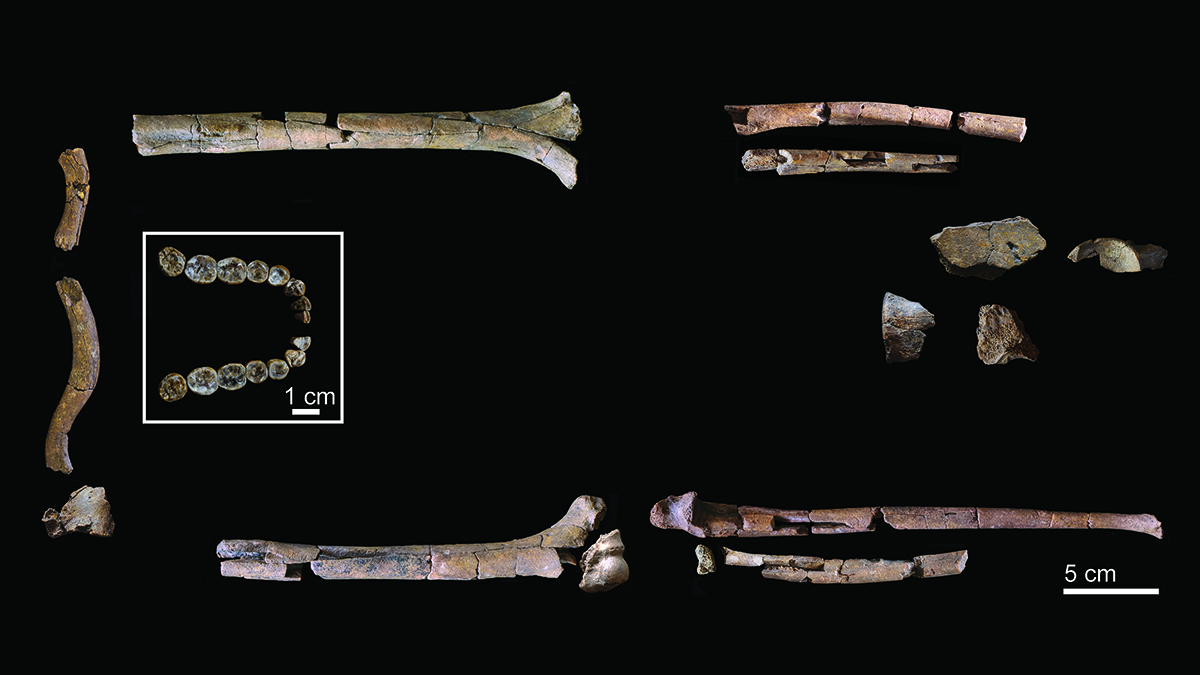
Most complete Homo habilis skeleton ever found dates to more than 2 million years ago and retains 'Lucy'-like features

Live ScienceWednesday, January 14, 2026 at 12:00:00 PM
PositiveScience
Most complete Homo habilis skeleton ever found dates to more than 2 million years ago and retains 'Lucy'-like features
  • Scientists have unveiled the most complete skeleton of Homo habilis, dating back over 2 million years, which exhibits features reminiscent of the famous fossil known as Lucy. This discovery marks a significant advancement in understanding early human ancestors and their physical characteristics.
  • The finding of this skeleton is crucial as it provides deeper insights into the evolutionary lineage of hominins, particularly in relation to Lucy, a pivotal figure in human evolutionary studies. It enhances the understanding of the anatomical traits that define early human relatives.
  • This development contributes to ongoing discussions about the diversity of early hominins and their coexistence, as recent discoveries of foot bones and other fossils suggest a complex web of relationships among various species, challenging previous notions of linear evolution and prompting further investigation into the dynamics of early human life.
— via World Pulse Now AI Editorial System

Was this article worth reading? Share it

Recommended apps based on your readingExplore all apps
Continue Readings
Scientists Find Extinct Rhino DNA in Wolf Pup Mummy’s Stomach
PositiveScience
Scientists have successfully sequenced the genome of the woolly rhinoceros, a species that has been extinct for thousands of years, from remains discovered in the stomach of a naturally mummified Pleistocene wolf pup. This significant finding sheds light on the dietary habits and ecological interactions of these ancient species during the Pleistocene epoch.
What a Wolf Pup’s Stomach Revealed About the Woolly Rhino’s Extinction
NeutralScience
Scientists have successfully sequenced the genome of the woolly rhino using a specimen preserved in Siberian permafrost, revealing insights into the extinction of this giant mammal. This high-quality genomic data provides a clearer understanding of the species' biology and the environmental factors that contributed to its decline.
Some objects we thought were planets may actually be tiny black holes from the dawn of time
NeutralScience
Scientists have proposed that some of the over 6,000 exoplanets identified beyond our solar system may not be planets at all, but rather tiny black holes formed in the early universe. This hypothesis suggests a need to reevaluate how celestial objects are classified and understood.
How Earth's orbit might help us find oil reserves within the planet
NeutralScience
Scientists studying Jurassic rocks in China have discovered that cyclical changes in Earth's orbit have influenced both climate and the formation of shale oil reserves. This finding highlights the intricate relationship between planetary movements and geological processes.

Ready to build your own newsroom?

Subscribe to unlock a personalised feed, podcasts, newsletters, and notifications tailored to the topics you actually care about