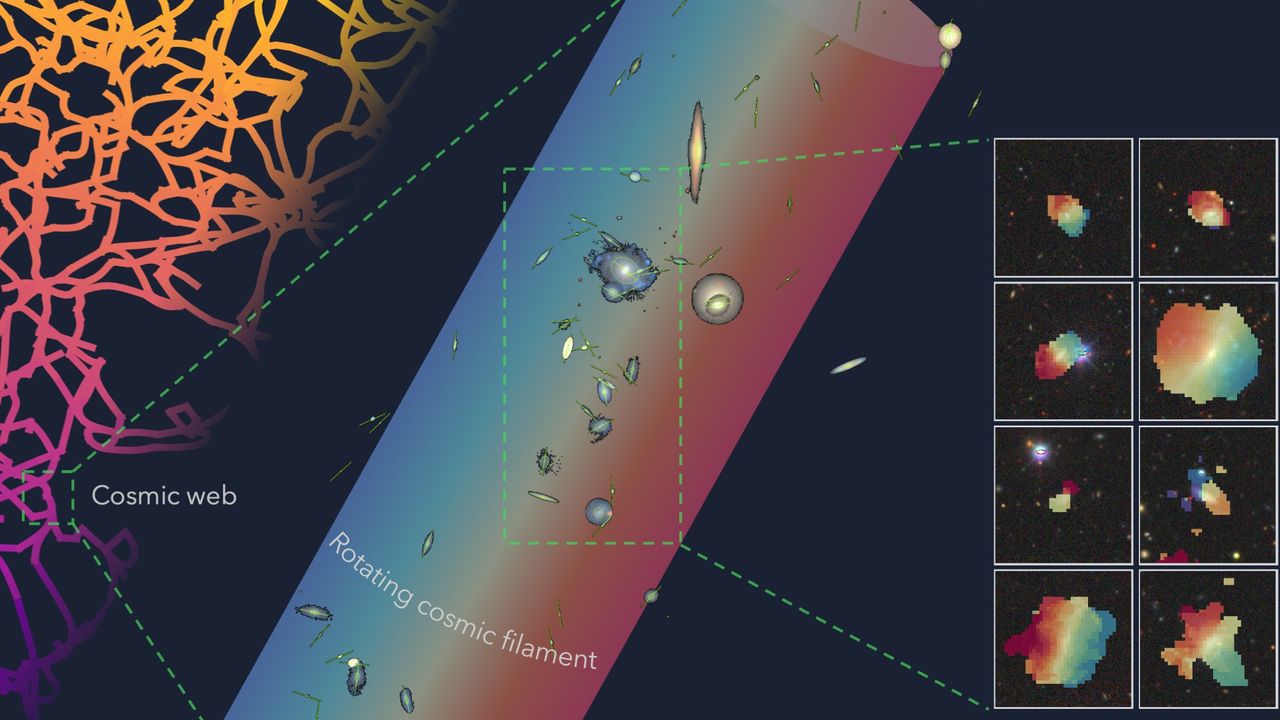
Giant rotating string of 14 galaxies is 'probably the largest spinning object' in the known universe

Live ScienceThursday, December 4, 2025 at 12:01:00 AM
PositiveScience
Giant rotating string of 14 galaxies is 'probably the largest spinning object' in the known universe
  • A giant rotating filament of 14 galaxies has been identified, potentially representing the largest spinning structure observed in the universe. This discovery may provide insights into the formation and evolution of galaxies within the cosmic web.
  • The significance of this finding lies in its potential to enhance understanding of galaxy formation processes, as well as the dynamics of cosmic structures. This could lead to new theories regarding the evolution of the universe and the interactions between galaxies.
  • This discovery aligns with recent astronomical findings, including a massive gas bridge connecting dwarf galaxies and the largest simulation of the universe, which collectively highlight the intricate relationships and structures within the cosmos, emphasizing the ongoing exploration of galaxy formation and the influence of the cosmic web.
— via World Pulse Now AI Editorial System


Was this article worth reading? Share it

Recommended apps based on your readingExplore all apps
Continue Readings
China has planted so many trees it's changed the entire country's water distribution
PositiveScience
China has undertaken extensive tree planting initiatives over recent decades, significantly altering the country's water distribution and activating its water cycle in ways that are beginning to be understood by scientists.
Death Valley's 'world's hottest temperature' record may be due to a human error
NeutralScience
A recent analysis of temperature records from Death Valley indicates that the world record for the highest near-surface air temperature, recorded at 134°F in July 1913, may be erroneous. This assessment covers temperature data from 1923 to 2024, suggesting potential inaccuracies in historical measurements.
When an AI algorithm is labeled 'female,' people are more likely to exploit it
NegativeScience
A recent study revealed that participants in the 'Prisoner’s Dilemma' game were less likely to cooperate when faced with male players, whether human or AI, while they tended to exploit those labeled as female. This suggests a bias in how individuals perceive and interact with AI based on gendered labeling.
James Webb telescope spots strange 'super-puff' planet frantically chasing its own atmosphere through space
NeutralScience
The James Webb Space Telescope has made significant observations of the exoplanet WASP-107b, revealing that its atmosphere is rapidly escaping into space. This phenomenon, described as a 'super-puff' planet, indicates that the planet's gaseous envelope is being lost at an alarming rate, raising questions about its long-term stability and composition.
Anacondas became massive 12 million years ago — and it worked so well, they haven't changed size since
PositiveScience
Anacondas reached their massive size approximately 12 million years ago, a development that allowed them to thrive even as other giant reptiles faced extinction due to cooling temperatures and reduced habitats. This remarkable adaptation has enabled them to maintain their size without significant changes since that time.
Law of 'maximal randomness' explains how broken objects shatter in the most annoying way possible
PositiveScience
A new mathematical equation has been developed that describes the distribution of fragment sizes when objects break, revealing that this distribution is consistent across various materials, including bubbles and spaghetti. This phenomenon is referred to as the 'law of maximal randomness.'
Elaborate 2,700-year-old tomb in Greece contains burial of a woman with an upside-down crown
PositiveScience
Archaeologists in Greece have uncovered a lavish 2,700-year-old tomb belonging to a noblewoman, which features an intriguing upside-down crown, symbolizing lost power. This discovery sheds light on the burial practices and social hierarchies of ancient Greek society.
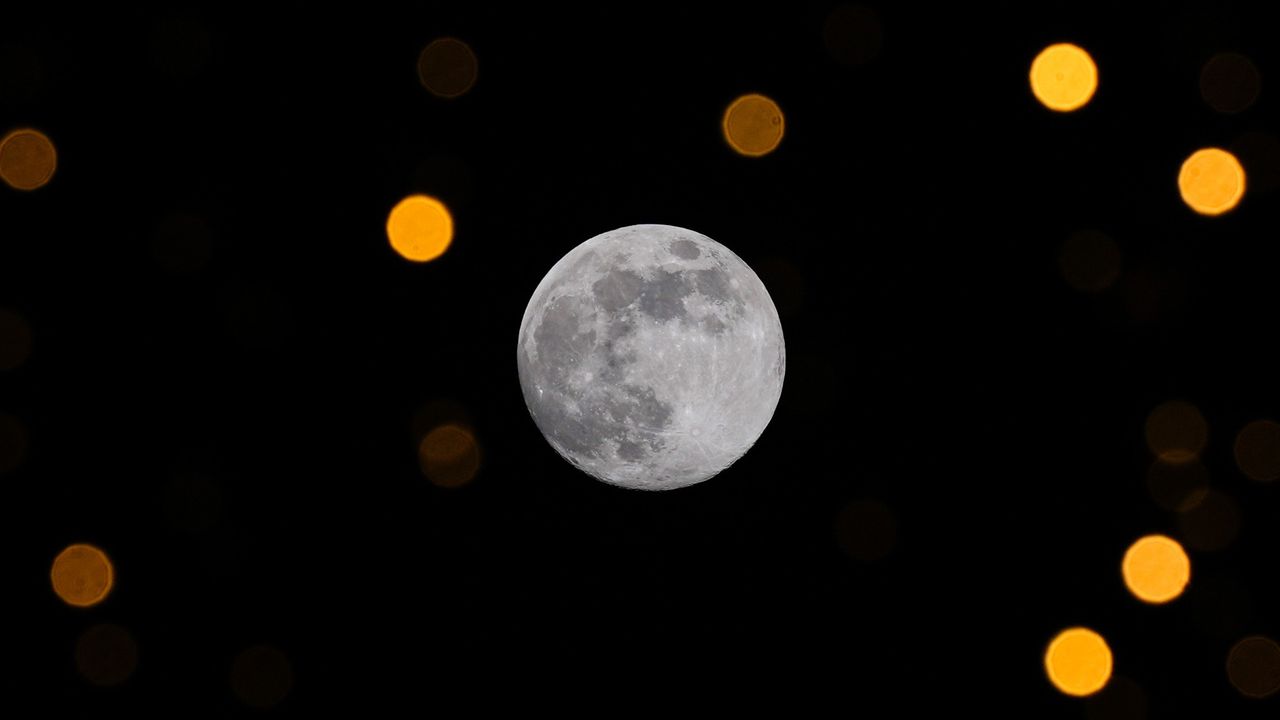
'Cold Supermoon' 2025: Why the final full moon of the year also towers highest
PositiveScience
The Cold Moon, the final full moon of 2025, will rise on December 4, reaching its highest point in the night sky, marking a significant celestial event for stargazers. This full moon is also known as the 'Cold Supermoon' due to its occurrence in winter, a time when the moon appears particularly bright and large.