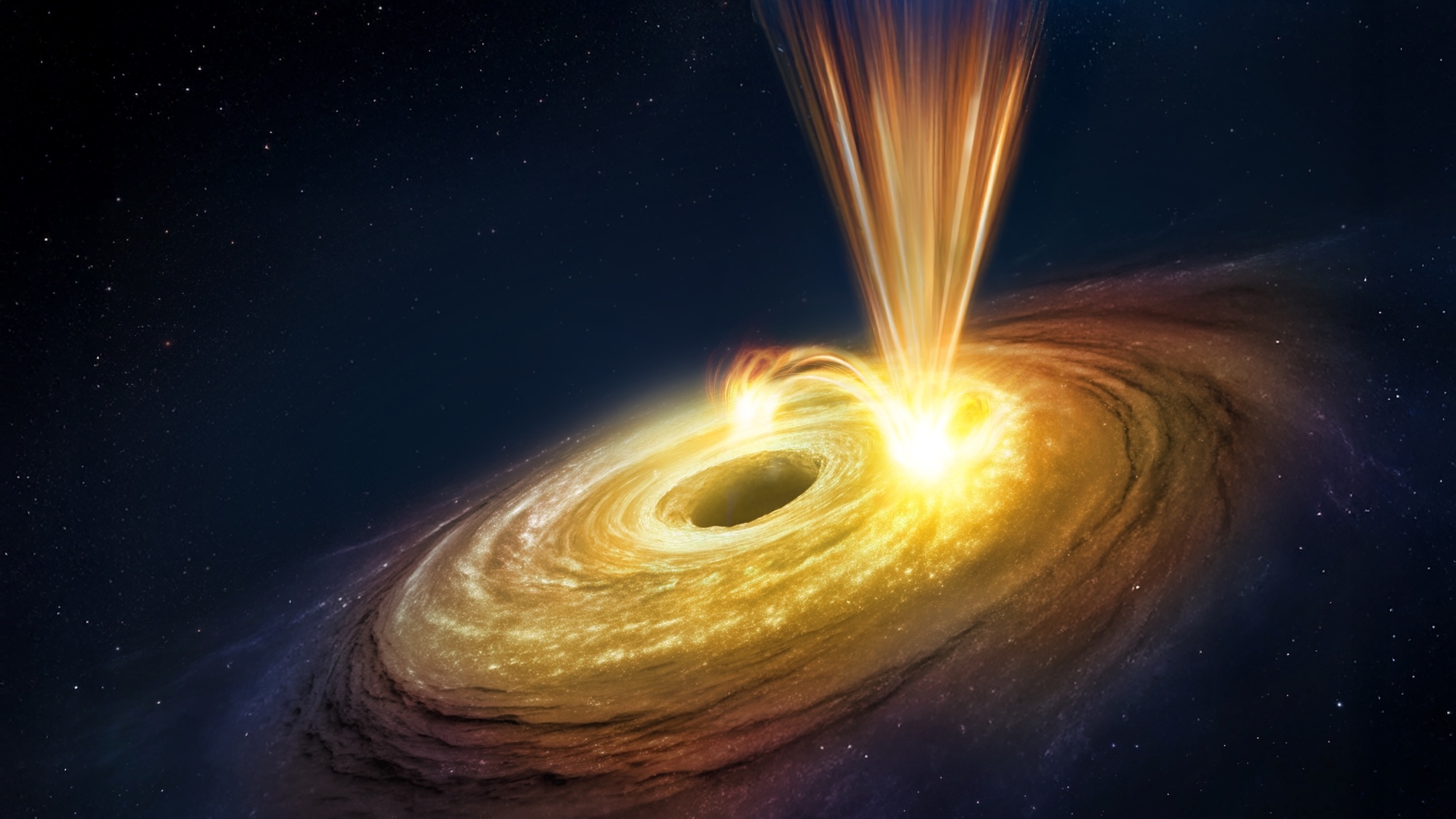
Black Hole Caught Blasting Matter into Space at 130 Million MPH

Scientific AmericanTuesday, December 9, 2025 at 2:45:00 PM
NeutralScience
  • A supermassive black hole has been observed ejecting matter into space at speeds reaching 130 million miles per hour, as detected by X-ray space telescopes. This phenomenon highlights the dynamic nature of black holes and their ability to influence their surroundings significantly.
  • The observation of such high-speed matter ejection is crucial for understanding the mechanisms behind black hole activity and the impact these cosmic giants have on their host galaxies. It underscores the importance of advanced observational technologies in astrophysics.
  • This event is part of a broader narrative regarding black holes, including recent discoveries of extraordinary flares and eruptions that can illuminate vast regions of space. Such findings contribute to a deeper understanding of cosmic phenomena and the potential effects of black holes on galactic evolution.
— via World Pulse Now AI Editorial System

Was this article worth reading? Share it

Recommended apps based on your readingExplore all apps
Continue Readings
This 7-hour cosmic explosion is the longest gamma-ray burst ever seen. Could it be from an elusive class of black hole?
PositiveScience
A recent cosmic event has been identified as the longest gamma-ray burst ever recorded, lasting seven hours, which has intrigued astronomers and raised questions about its origin, potentially linked to a rare class of black holes. This unprecedented outburst is described as unlike any other observed in the past 50 years.
Human Missions to Mars Must Search for Alien Life, New Report Finds
PositiveScience
A new report emphasizes that future human missions to Mars should prioritize the search for extraterrestrial life, highlighting the importance of this endeavor in understanding the planet's potential for hosting life. The study outlines strategic plans for crewed missions aimed at uncovering signs of life beyond Earth.
Pompeii House Frozen Mid-Renovation Reveals Secrets of Roman Cement
PositiveScience
Recent excavations in Pompeii have uncovered a house frozen mid-renovation, revealing lime granules in the ancient walls that suggest the Romans used a reactive hot-mix method for making concrete. This finding highlights the advanced construction techniques employed by the Romans nearly 2000 years ago.
OpenAI’s Secrets are Revealed in Empire of AI
PositiveScience
Karen Hao's investigation in 'Empire of AI' reveals the inner workings of OpenAI, emphasizing that the future of artificial intelligence remains within human control. The book is featured on the 2025 Best Nonfiction of the Year list, highlighting its significance in understanding AI's trajectory.
This Weekend’s Geminids Meteor Shower Should Be Spectacular
PositiveScience
The Geminids meteor shower, which began on December 4, is anticipated to peak on the night of December 13-14, 2025, providing an exceptional opportunity for skywatchers to observe up to 150 meteors per hour under ideal conditions. This annual event is renowned for its vibrant and colorful shooting stars, making it a highlight in the astronomical calendar.
Breakthrough in Digital Screens Takes Color Resolution to Incredibly Small Scale
PositiveScience
A breakthrough in digital screen technology has led to the development of miniature displays that can match the size of a human pupil, featuring a pixel density equivalent to the number of photoreceptors in the eye. This advancement is expected to significantly enhance the quality of virtual reality experiences.
Supermassive black hole belches 30,000-miles-per-second winds
NeutralScience
Two X-ray space telescopes have observed a supermassive black hole emitting winds at speeds of 30,000 miles per second, a phenomenon captured 130 million light-years away. This unprecedented observation provides new insights into the behavior of such cosmic entities.
Chernobyl’s Shield Guarding Radioactive “Elephant’s Foot” Has Been Damaged for Months
NeutralScience
The shield protecting the radioactive mass known as the 'Elephant's Foot' at Chernobyl has been damaged for several months, yet officials report that radiation levels outside the plant have not increased. This situation highlights ongoing concerns regarding the integrity of the containment structures at the site of the world's worst nuclear disaster.